If you know me, you would know I am definitely not a tech-savvy person. I am such a lagger and 'lacker' in the newest and most current technological devices, softwares or programs. I supposed many of you would have known how to use Google Drive and Google docs eon years ago, but sadly I only learnt it last year, and am glad that I acquired it! I mean, better late than never right? There are just so many things to explore on the Internet, and it is impossible to learn it all even throughout my entire life. But let us take baby steps from Abel's class...
So one thing I explored today was the function of Google image. In the past I would always use the default function - the basic search. But after this week's lesson I realised there is an advanced search, which really makes my life so much easier!
For example, when I use the basic search to search for 'India pink textiles' on Google image, it comes out so many different pictures which may not be relevant to what I'm looking for. And sometimes it frustrates the hell out of me. Take a look at the picture below and you would understand.
Look at some of the pictures, do they even look close to what I'm searching for?! -.-
And then comes Google blessing me with the Advanced search tab (HALLELUJIAH~~) It has definitely made my life so much easier.
Hehe see what I mean?
Also, I have recently downloaded Google Earth on my laptop, and it has been so much fun!
Checking out Sydney heh heh
I am still learning how to use Google Earth but it has been pretty user friendly thus far, especially for an IT noob like me. But I'm pretty sure I will get the hang of it soon!
However, the downside of the Internet is that it kills the surprise in you everytime you learn something. I am going Sydney during the holidays and am in a dilemma whether to use Google Earth to check out some places. It leaves no surprise for me! Oh wells, that is the problem with virtual touring.
Worms, both disgusting in reality and in virtual reality. As the Internet becomes a World Wide Web, it is the same as becoming the Earth itself. Let me explain what this means. As we all know, the new deadly disease in this spreading in our world is Ebola. It erupted in the Africa region, amongst countries like Sierra Leone, Guinea and Liberia, and has now spread to first world countries like the United States. With increasing globalization, the spread of diseases is just one of the phenomena it brings about, as the number of people travelling to different countries heightened. Such trend is exactly simulated in the Internet and our computers. Worms, viruses and Trojans are malicious attacks which can easily be replicated and diffused themselves through different forms such as that of emails. Thus it is essentially important to update our computers regularly and to install anti-spyware software.
1: Install quality antivirus
Many computer users believe free antivirus applications, such as those included with an Internet service provider's bundled service offering, are sufficient to protect a computer from virus or spyware infection. However, such free anti-malware programs typically don't provide adequate protection from the ever-growing list of threats.
Instead, all Windows users should install professional, business-grade antivirus software on their PCs. Pro-grade antivirus programs update more frequently throughout the day (thereby providing timely protection against fast-emerging vulnerabilities), protect against a wider range of threats (such as rootkits), and enable additional protective features (such as custom scans).
2: Install real-time anti-spyware protection
Many computer users mistakenly believe that a single antivirus program with integrated spyware protection provides sufficient safeguards from adware and spyware. Others think free anti-spyware applications, combined with an antivirus utility, deliver capable protection from the skyrocketing number of spyware threats.
Unfortunately, that's just not the case. Most free anti-spyware programs do not provide real-time, or active, protection from adware, Trojan, and other spyware infections. While many free programs can detect spyware threats once they've infected a system, typically professional (or fully paid and licensed) anti-spyware programs are required to prevent infections and fully remove those infections already present.
3: Keep anti-malware applications current
Antivirus and anti-spyware programs require regular signature and database updates. Without these critical updates, anti-malware programs are unable to protect PCs from the latest threats.
In early 2009, antivirus provider AVG released statistics revealing that a lot of serious computer threats are secretive and fast-moving. Many of these infections are short-lived, but they're estimated to infect as many as 100,000 to 300,000 new Web sites a day.
Computer users must keep their antivirus and anti-spyware applications up to date. All Windows users must take measures to prevent license expiration, thereby ensuring that their anti-malware programs stay current and continue providing protection against the most recent threats. Those threats now spread with alarming speed, thanks to the popularity of such social media sites as Twitter, Facebook, and My Space.
4: Perform daily scans
Occasionally, virus and spyware threats escape a system's active protective engines and infect a system. The sheer number and volume of potential and new threats make it inevitable that particularly inventive infections will outsmart security software. In other cases, users may inadvertently instruct anti-malware software to allow a virus or spyware program to run.
Regardless of the infection source, enabling complete, daily scans of a system's entire hard drive adds another layer of protection. These daily scans can be invaluable in detecting, isolating, and removing infections that initially escape security software's attention.
5: Disable autorun
Many viruses work by attaching themselves to a drive and automatically installing themselves on any other media connected to the system. As a result, connecting any network drives, external hard disks, or even thumb drives to a system can result in the automatic propagation of such threats.
Computer users can disable the Windows autorun feature by following Microsoft's recommendations, which differ by operating system. Microsoft Knowledge Base articles967715 and 967940 are frequently referenced for this purpose.
6: Disable image previews in Outlook
Simply receiving an infected Outlook e-mail message, one in which graphics code is used to enable the virus' execution, can result in a virus infection. Prevent against automatic infection by disabling image previews in Outlook.
By default, newer versions of Microsoft Outlook do not automatically display images. But if you or another user has changed the default security settings, you can switch them back (using Outlook 2007) by going to Tools | Trust Center, highlighting the Automatic Download option, and selecting Don't Download Pictures Automatically In HTML E-Mail Messages Or RSS.
7: Don't click on email links or attachments
It's a mantra most every Windows user has heard repeatedly: Don't click on email links or attachments. Yet users frequently fail to heed the warning.
Whether distracted, trustful of friends or colleagues they know, or simply fooled by a crafty email message, many users forget to be wary of links and attachments included within email messages, regardless of the source. Simply clicking on an email link or attachment can, within minutes, corrupt Windows, infect other machines, and destroy critical data.
Users should never click on email attachments without at least first scanning them for viruses using a business-class anti-malware application. As for clicking on links, users should access Web sites by opening a browser and manually navigating to the sites in question.
8: Surf smart
Many business-class anti-malware applications include browser plug-ins that help protect against drive-by infections, phishing attacks (in which pages purport to serve one function when in fact they try to steal personal, financial, or other sensitive information), and similar exploits. Still others provide "link protection," in which Web links are checked against databases of known-bad pages.
Whenever possible, these preventive features should be deployed and enabled. Unless the plug-ins interfere with normal Web browsing, users should leave them enabled. The same is true for automatic pop-up blockers, such as are included in Internet Explorer 8, Google's toolbar, and other popular browser toolbars.
Regardless, users should never enter user account, personal, financial, or other sensitive information on any Web page at which they haven't manually arrived. They should instead open a Web browser, enter the address of the page they need to reach, and enter their information that way, instead of clicking on a hyperlink and assuming the link has directed them to the proper URL. Hyperlinks contained within an e-mail message often redirect users to fraudulent, fake, or unauthorized Web sites. By entering Web addresses manually, users can help ensure that they arrive at the actual page they intend.
But even manual entry isn't foolproof. Hence the justification for step 10: Deploy DNS protection. More on that in a moment.
9: Use a hardware-based firewall
Technology professionals and others argue the benefits of software- versus hardware-based firewalls. Often, users encounter trouble trying to share printers, access network resources, and perform other tasks when deploying third-party software-based firewalls. As a result, I've seen many cases where firewalls have simply been disabled altogether.
But a reliable firewall is indispensable, as it protects computers from a wide variety of exploits, malicious network traffic, viruses, worms, and other vulnerabilities. Unfortunately, by itself, the software-based firewall included with Windows isn't sufficient to protect systems from the myriad robotic attacks affecting all Internet-connected systems. For this reason, all PCs connected to the Internet should be secured behind a capable hardware-based firewall.
10: Deploy DNS protection
Internet access introduces a wide variety of security risks. Among the most disconcerting may be drive-by infections, in which users only need to visit a compromised Web page to infect their own PCs (and potentially begin infecting those of customers, colleagues, and other staff).
Another worry is Web sites that distribute infected programs, applications, and Trojan files. Still another threat exists in the form of poisoned DNS attacks, whereby a compromised DNS server directs you to an unauthorized Web server. These compromised DNS servers are typically your ISP's systems, which usually translate friendly URLs such as yahoo.com to numeric IP addresses like 69.147.114.224.
Users can protect themselves from all these threats by changing the way their computers process DNS services. While a computer professional may be required to implement the switch, OpenDNS offers free DNS services to protect users against common phishing, spyware, and other Web-based hazards.
Hello people! So as you all know, we need to come up with a video and upload it on youtube. This is definitely my first attempt and honestly I feel so excited about. Cuz since its gonna be on youtube, it means everyone around the world is gonna see my face! Thats a huge deal as I'm normally considered low-profile lol. But anyways, here's the video!
How To Make A Simple Green Smoothie:
Making this video makes me realise how tough it is to film something, even if it's just for a few minutes. It took me 1 full day to produce this video which only takes 2 mins. As this was my first attempt, it may have taken me way longer than how much time you veterans out there usually spend. But the whole process was pretty worth it and fun! I used iMovie to edit the video and it turned out way better than what I expected. It is definitely a tool that I have acquired through this practice and I am looking forward to film and edit more stuff with it. iMovie is very user-friendly, albeit the downside is that it causes Mac's desktop to blackout. Other than that it was fine. I was able to cut and edit easily and there were even different music and song selections to go along with the video. Also, many design elements such as choice of fonts, background, etc were all included. I would definitely recommend this function for anyone looking to edit their videos.
Last but not least, enjoy making this healthy smoothie from my video! :)
In this 21st century, where most of our youngsters come from the Y generation, it is of no surprise that many education institutes are making use of digital media to enhance students' learning experience. Learning is definitely made effective through the use of such digital media, and I believe students are enjoying the process of it!
Digital learning allows us to be exposed to many different things. We do not just simply rely on the textbooks which can only go so far. With the help of the Internet and computers, learning can go far beyond that. We can watch videos to understand a scientific process better, we can learn social knowledge through watching a particular video, or do experiments and research through surveys and data collection from the use of the Internet. There are so many things to make learning more interesting. When learning becomes a form of interest, we learn better and fast, and this is taken from Affective domain by Bloom's taxonomy. And from experience, this is definitely true. Though i dislike using word documents or some form of digital media devices to take notes during lesson, I enjoy doing research on the Internet as compared to conventional methods of finding information in the library. The latter is so much more tedious and time consuming as compared to the unorthodox way of learning with digital media. I love it when lecturers can upload videos relating to what they teach to give me an overall idea of the topic itself. These videos often leave longer lasting impressions on me and knowledge is entrenched in me.
Many believe the Internet is private. Since the Internet may be used in the privacy of homes or offices, there is a misconception that transactions are private. But this may not be the case. There is bound to be some form of record created. Disintermediation is the driving force behind e-commerce. It assumes there is nothing between the seller and a customer, except a direct and personal connection from one computer to another, from one browser to another. Is there really a direct and personal connection? What are the implications for security and privacy?
Mr. Gerstner at CeBIT '98 reflected on the current state of electronic business, by examining the increasing computing power of systems ("Deep Computing") and the sophisticated algorithms that permit powerful levels of data mining. He spoke about the rise of global networks that create in turn a networked economy:
"The next milestone is what we call "pervasive computing." Fifty years ago, where did you find electric motors? In factories and power plants. They were big and expensive. Today, you might find 100 electric motors in the typical home. They're in appliances, the heating and ventilation system, the CD player, the VCR, and if you're fortunate enough, the electric toothbrush. We don't buy electric motors. They come inside all the things we use every day.
The same thing is happening with computing devices. Chips are getting so small and inexpensive, they're being embedded in everything: cars, appliances, tools, doorknobs, clothes. Most significantly, all these tiny intelligent devices will be interwoven in the global fabric of computing and communication.
And soon we'll see this hyper-extended networked world - made up of a trillion interconnected intelligent devices - intersecting with the data mining capability I spoke of earlier. "Pervasive computing" meets "Deep Computing." Companies and institutions will amass more data, more information than ever in history - and for the first time be able to do something productive with it - turn raw data into knowledge and move that knowledge to the right people instantaneously. Personally, I believe that future leadership institutions of all kinds will be those that know how to compete and win on the basis of knowledge - learning, adapting and improving using this vital asset we know as information.
While the benefits to be gained are immense, the potential pitfalls are just as large. The security of e-commerce decreases as its functionality requires the use of distributed applications that execute many transactions against multiple databases. On the surface it may seem rather easy for transactions to be made, straightforward and simple, but what lies deep down is the complexity of records, chips, and databases that happened in the Internet. Afterall, it is not as simple as it seems.
Given the potential for abuse, it is highly likely laws and regulations will begin controlling privacy and security mechanisms. However, it may be a good thing that there is some form of government intervention, and there is some sort of evidence to show this. In a recent Business Week/Harris poll, most of the participants cited privacy issues as the number one reason they are not using the Internet. In the same poll, 78% of extremely active Internet users said they would use the World Wide Web more if there was a guarantee of their privacy. Another 50% of those polled were of the opinion that the U.S. government should pass laws as soon as [possible to manage the issues of digital collection of personal data.
Social media is such an easy and effective way to turn many businesses lucrative. With the vast networks and users up on social media, it is so direct and easy to build brand awareness and engage with customers. Other than businesses, there are campaigns reaching out to the masses to raise awareness on certain social issues as well. Below are 3 successful companies which used social media marketing the right way.
WATERisLIFE Campaign
WATERisLIFE is a non-profit organization that strives to bring clean water to those in need. Their long-term goal is to save lives and transform villages in dire need of water to self-sufficient thriving communities. As with any non-profit looking to raise awareness, WATERisLIFE needed support.
Their social media marketing strategy team took a unique approach. Instead of starting a new Internet trend to build awareness, they decided to end one. The challenge was figuring out how to do so without offending followers of the trend while inspiring action at the same time.
The organization set out to reverse the popular ‘#firstworldproblems’ trend used to voice silly complaints of the privileged -- tweets such as the ff:
"I hate it when my phone charger won’t reach my bed."
"When I go to the bathroom and I forget my phone"
"I hate when my leather seats aren’t heated."
"When my mint gum makes my ice water taste cold"
WATERisLIFE filmed a documentary featuring the men, women, and children in Haiti reading the hashtagged tweets. The video showed them in a real setting where their poverty and strife is apparent, a stark contrast far detached from the tweets they were reading. The contrast highlighted #firtsworldproblems as downright ridiculous and ignorant. The project took a team of eleven people four months to complete.
The video ended with a striking notion – “First world problems…aren’t problems.”
The video was an absolute success. The message was received with gratitude as audiences began to share what they were thankful for in place of first world problem complaints. In just four days the video received over 1 million views. Since it’s debut, the views have more than doubled.
Ultimately, the campaign generated a generous response of 1 million days worth of clean water for poor communities.
Dove: Real Beauty Sketches
Dove beauty supplies had a very specific goal in mind when they launched their Real Beauty Sketches campaign in April of 2013. They wanted to generate more sales and leads by reducing their overall environmental footprint and increasing positive social impact. Their social media marketing team took a close look at their biggest consumer group -- women. They investigated a striking trend in behavior of the self-perception of women and came to a single significant recognition:
Women are their own worst critics.
The challenge was to create a campaign that encouraged beauty as a source of confidence. Dove hired an FBI sketch artist to illustrate real women and produced a video documentary of an experiment they conducted. The artist produced two portrait drawings of the women without seeing their faces -- one as described by the subject of the portrait and another as described by an acquaintance of the subject. The difference between each sketch was astonishing.
Whilst the women focused on their physical flaws, their acquaintances saw and described the beauty in them. When the women saw this notion reflected on the portraits, they were moved. And so were the viewers.
To date, over 114 million people have watched the video which went viral on social media outlets. The compelling video also became the number one viewed online video ad of all time within a month of launching. It also holds the record for the most shared video ad of all time.
Frito-Lay: Do us a flavor
Frito-Lay, the popular snack company, wanted to develop a campaign that would increase consumer engagement with their brand.
So the company created a campaign that allowed their audience to know that their opinion matters, that they have a say and that the company is listening.
The campaign was aimed at engaging with consumers through social media channels and to stretch beyond the shelf life of an average marketing splash.
The ‘Do Us a Flavor’ campaign accomplished both. The initial launch of this campaign was in October of 2012. The company raised the bar to encourage everyone to participate by offering $1 million dollars to the winner (or 1% of the 2013 net sales for the winning product).
Over 3.8 million people across 14 countries submitted their ideas for the next flavor craze through a Facebook app created by Frito-Lay. The campaign generated 955 million organic Facebook impressions and 1.26 billion PR impressions, boosting sales by 12%.
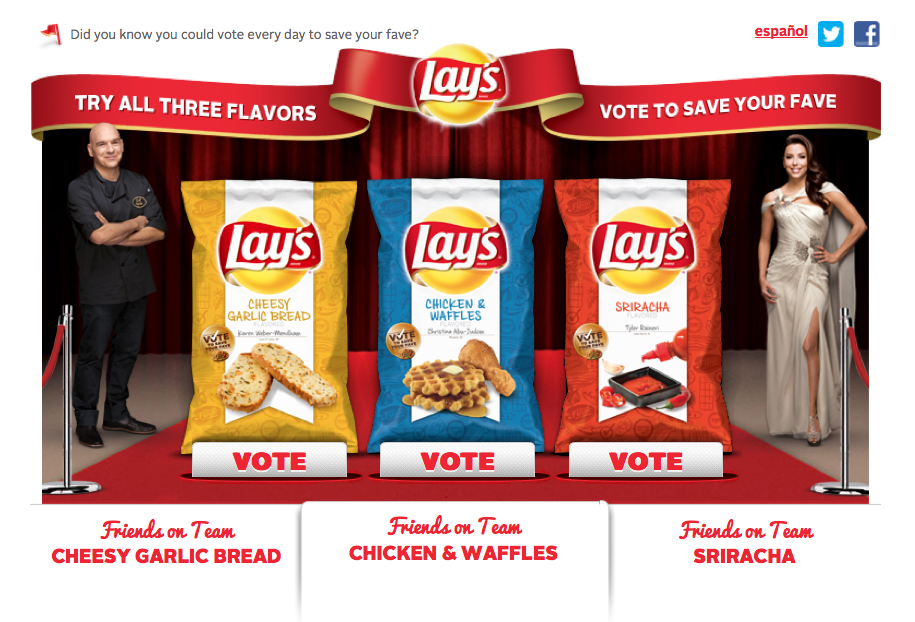
As planned, the campaign didn’t stop there. It stretched into 2013 with three finalist flavors:
Cheesy Garlic Bread
Chicken & Waffles
Sriracha
Early this year, the company stocked shelves with these consumer picked flavors and once again took the decision to the social media channels. Consumers could try the new flavors and vote for their favorite online.
This week I'm gonna talk about the use of Social Media (SM) and how various companies are making good use of these platforms to expand their businesses.
A very distinct company which uses SM to reach out to customers is MDS Collection, a brand that sells female fashion apparels and accessories.
Before using SM, this company was just like any other companies with different outlets located in prominent shopping malls like Wisma Atria, Bugis Junction, etc. From what I have seen, the stores were usually empty and there was only a handful of customers whenever I patronize. It only started using SM to promote their brand in 2014, which seems pretty successful albeit a late-starter. I went in the store and was about to purchase an item when the sales girl notified me about a promotion they were having at the time. Of course my eyes lit up at the thought of discounts discounts and more discounts! The promotion was to either follow their Instagram account or to like their Facebook page, and I would be entitled to 15% discount right away. It was as simple and accessible as that for me to save some bucks. But obviously that was a strategy for them to gain customers through the SM and making use of reviews and pictures of customers to expand their brand. It was like a free and accessible advertising strategy they employed to gain popularity. And the result? Definitely a success in such a short period of time.
As I am typing this, they are currently having a promotion whereby they are giving free giveaways for customers who take pictures of themselves in MDS Collection outfits and to post them on Instagram, with hashtag #mdsootd. Such promotions come once every few months, and I think it's a very sustainable kind of marketing strategy.